The benefits of digitization
Latupeirissa et al (2024) add their voices to a message that is becoming more and more obvious with time: digitization improves organizational efficiency, reduces administrative challenges and lowers costs and environmental impact. Molinuevo (2020) adds that digital databases enable better data management and storage, and points to the crucial role they played during the pandemic from the point of view of the psychosocial services that were already using them.
Even more help with electronic signatures on ASO
ASO already greatly reduces the need to keep information on paper by providing you with a digital database where your data is protected and accessible to the relevant team from multiple locations, instantly. At the same time, we recognize that paper still has advantages in certain usage scenarios. For example, when initializing or signing a document.
Indeed, in the past, people using ASO still relied on paper to collect initials and signatures. Documents were then either stored in a physical space, or scanned and uploaded to ASO at the appropriate locations. While these working methods are still valid, we're always looking for new, even more efficient solutions.
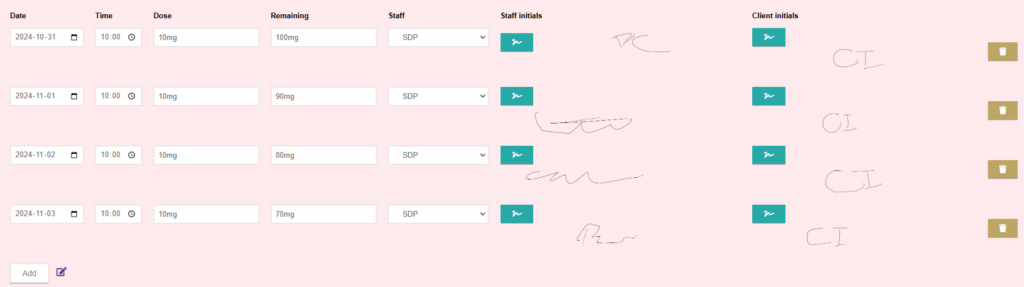
We are pleased to introduce the ability to sign directly in ASO. On a computer, the signature can be made using a mouse. On a touchscreen device, you can sign with your finger or even a stylus. These fields can be deployed for single use (a signature or initials in a specific place in a file or form: figure A) or for repeated use (a signature or initials for each entry in a linked list: figure B).
These new fields therefore allow you to remain in the ASO environment and add your own signature or initials, or else give the user the opportunity to do so themselves.
Coming soon: two-factor authentication via signature and the "Paperless" app.
Towards optimized digital management with ASO's legal electronic signatures
Although signatures and initials are common in contexts where ASO is used, these inscriptions are not always collected for their legal value. In this use case, the fields presented above meet the targeted need: a mark that demonstrates the person's commitment to the process. However, sometimes the signature does have legal value, such as for an authorization to exchange information. In these cases, the signature must be validated from a legal standpoint. Our development team is currently identifying the best methods of two-factor authentication to allow users to create a digital signature that has legal value. It will then be possible to decide which signature fields require this two-factor authentication.
Finally, we are also working on a project that will further reduce the need for paper: an application that will allow documents currently used on paper to be completed on a tablet. Paper is also useful because it allows us to hand out documents that are longer and take more time to read and complete (e.g., code of conduct) or because we can take them with us to places where a computer would be less practical to carry around (e.g., room inspection checklist). The new application would not display any confidential ASO information; it would only be used to submit completed/signed documents directly to the right place in ASO.
It all starts with the creation of your digital document directory. Place the original versions of your documents in the appropriate section of ASO. Then, using the tablet, simply enter the user's unique identifier (ID) and select the document you wish to complete. The image of the document will then be displayed on the tablet and can be viewed and completed directly on-screen. Images of completed documents are then saved directly in the [Documents] section of the user's folder.