A new initiative from SDP
Hello and thank you for joining me for this first article. This monthly publication, available on our website and through our newsletter, seeks to contribute to the application of academic knowledge in the field where practitioners work on a daily basis. The mission reflects my own academic and professional background. I myself began my career as a volunteer at the Montreal Suicide Prevention Center (formerly Suicide Action Montreal) while pursuing my bachelor's degree in psychology, wondering if I would really like to try to apply what I was learning in class. Personally, it was an enriching experience that helped me reconcile myself with the scientific rigor required by the academic world, which allows for greater confidence in the validity of the principles guiding our interventions. I then had the opportunity to work in various crisis centers and suicide prevention centers as a counselor and returned to CPSM, where I had the chance to take on a new challenge as clinical manager. It was during this time that I rediscovered the impact that technology could have on intervention by collaborating on two crucial projects: digital suicide prevention intervention (chat and text messaging) and the adoption of a first database for all CPSM operations (ASO). I then joined the SDP team.
Today, I'm speaking to you as ASO Product Manager. I'm proud to occupy this role within SDP's diverse and talented team. As mentioned above, I believe that a database such as ASO represents an incredible opportunity to integrate innovative concepts from academic research directly into the day-to-day operations of your organization. In fact, the database already hosts an incredible wealth of data enabling the resource to function properly. Sometimes, it's simply a matter of analyzing this data in a new way to deduce potential leads. At other times, it's by equipping ourselves with new tools that we can enhance operations and make work more fluid, pleasant and collaborative in nature. Such is the case with the module featured in this very first article: the case discussion module.
What is the case discussion on ASO?
First, we must give credit to Maison Grise, which made the initial request for a case discussion module. After a few exchanges between our team and our contacts at Maison Grise, the main features of the module were chosen. The primary objective of the module was to create a space for discussion that reflects the 24/7 reality of several organizations. It is difficult to bring together all the team members who may need to interact with the people discussed during team meetings. In addition, live exchanges, such as during team meetings, are extremely valuable (Laurent, 2017), but it is not always possible to bring together all the participants or to conclude all the discussions that have been started. This is where the case discussion module complements existing practices by enabling confidential exchanges between all relevant stakeholders in an asynchronous manner.
Asynchronous exchanges: how to optimize the effectiveness of asynchronous case discussions
First of all, a brief definition of the word "asynchronous": not occurring at the same time. Indeed, the case discussion module does not seek to be a tool that supplants the real-time exchange that is already integrated into the practices of the majority of organizations. Rather, it's a module where you can anticipate the logical follow-up to a discussion begun in real time, or even start a discussion entirely in asynchronous mode. Here are a few winning principles for using this module:
– Choosing the right people to talk to: It can be tempting to include everyone on our team in every case discussion. However, the discussion in question isn't always relevant to the entire staff. Sometimes, good judgment is needed to determine which part of the team should participate in the case discussion and which part of the team can learn the outcome of the case discussion and offer their views afterwards. The module therefore allows you to control which staff members have access to the discussion throughout its entire duration. Participants can be added or even removed at any time.
– Organization of the discussion in a discussion forum format: the choice of the initial format for the case discussion module draws on the familiarity of discussion threads as found on several social networks such as Facebook and YouTube. Obviously, we are not trying to replicate the type of exchange that can sometimes be seen under a post about a new stop sign on "SPOTTED: Saint-Bruno," even if it can be entertaining to read. Below, we highlight some best practices to keep discussions relevant and useful.
– Exploration beyond the discussion forum model: Gao et al. 2012 detail in their article how we can go beyond the discussion forum model by integrating technological advances. In ASO, it is possible, among other things, to upload files of any type. One of the next developments in the case discussion module will therefore be the inclusion of a feature allowing users to record their responses in audio format. This will capture the qualities specific to a spoken response: tone of voice, speech rate, intonation, etc.
– Facilitating and structuring the discussion: In his article, Gilbert 2014 emphasizes the importance of case discussion "facilitators." These individuals play a crucial role in developing and presenting a summary of the facts and desired objectives, encouraging participation, and ensuring that the discussion is goal-oriented. It is therefore beneficial to identify the person or persons who will play this essential role for each case discussion throughout its duration.
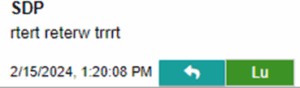
– Keeping the discussion alive: It would be a shame if the benefits offered by the case discussion module were lost because discussions are not continued on ASO. For this reason, visual notifications highlight in red those discussions in which replies have not yet been marked as read. The first screenshot shows the red tab and the second screenshot shows the [Read] button.
– Take advantage of synchronous exchange: it may seem surprising that we are back to praising the merits of real-time or even face-to-face discussion, but technology has its limits, and the same goes for synchronous discussion. Sometimes, you have to recognize that you have reached maximum productivity on the case discussion module and that it is time to discuss it in person in order to choose an alignment.